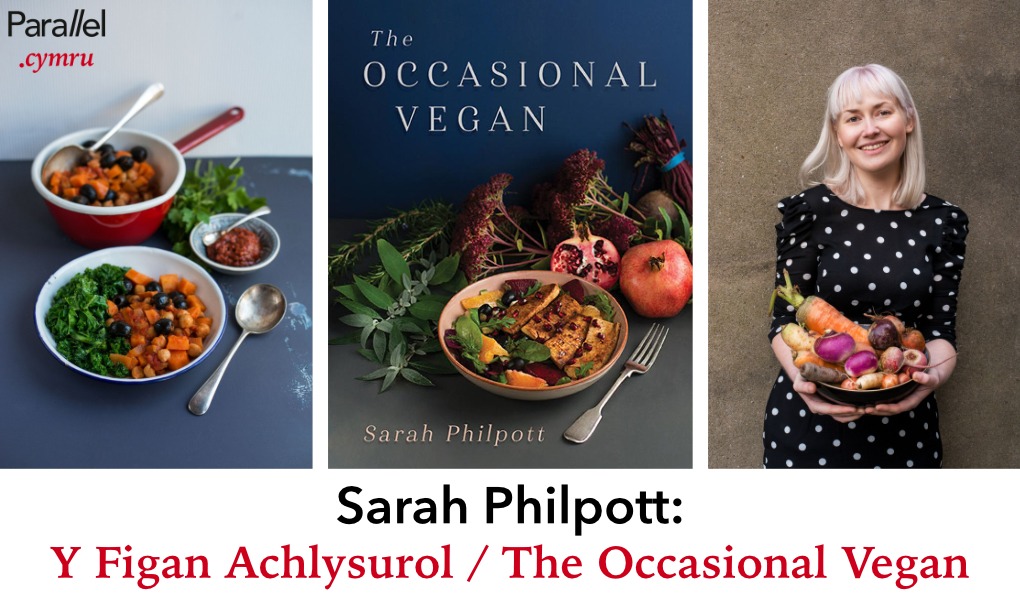


Vegan dishes are often quick and straighforward to prepare, and it’s usually healthier and cheaper when omitting meat. Sarah Philpott’s first book, The Occasional Vegan, presents 70 simple, affordable and delicious recipes, suitable for newcomers and long-time vegans alike, that will all keep you well-fed and healthy. In an exclusive column for parallel.cymru, she takes us through some of these recipes while also sharing her own experiences and insights.
Mis Ionawr / January 2019: Veganuary
Mae’r Dolig drosodd ac mae’n amser pacio i ffwrdd y goeden a’r tinsel – ac os ydych chi’n trio Veganuary eleni – y twrci hefyd…
Christmas is over and gone are the tree, the tinsel – and if you’re trying Veganuary this January – the turkey, too…
| Veganuary yw’r sialens flynyddol lle mae pobl yn ceisio peidio bwyta cig nag unrhyw fwydydd eraill sy’n dod o anifail trwy gydol mis Ionawr – ac eleni, mae’n boblogaidd iawn. Hyd yn hyn, mae dros 250,000 o bobl wedi cofrestri, i’w gymharu â 168,542 yn 2018 and dim ond 3,300 yn 2014 pan ddechreuodd yr ymgyrch. | Veganuary is the annual challenge for people to try to cut out meat and other animal-based products for the month of January – and this year, it’s huge. So far this year, more than 250,000 people have signed up, compared to 168,542 in 2018 and just 3,300 in 2014 when it started. |
| Mae’n wir bod Veganuary wedi dangos bod bwyta’n figan yn opsiwn hygyrch, ond pam fod figaniaeth mor apelgar ar y foment? Mae llawer o bobl yn pryderu am lles anifeiliaid, ac nid dim ond o fwyta cig. Yn y diwydiant llaeth, mae buchod yn cael eu cysylltu i beiriannau godro dwy waith y dydd neu fwy ac yn cael eu gwneud yn feichiog gan semeni artiffisial pob blwyddyn. Mae eu lloi wedyn yn cael eu cymryd o’u mamau diwrnodau ar ôl eu geni er mwyn eu troi yn gig llo. Yn aml, gallwch glywed y mamau yn galw am eu babis am ddiwrnodau wedi hynny. | Veganuary has certainly made eating a plant-based diet an accessible choice, but why is veganism having such a moment? Animal welfare is a concern for many, and we’re not just talking about meat. In the dairy industry, cows are hooked up, two or more times a day, to milking machines and are impregnated by artificial insemination every year. Their calves are then taken away days after birth to produce veal flesh. Mother cows can often be heard calling for their calves for days afterwards. |
| Nid oes defnydd i gywion gwrwaidd mewn cynhyrchiad wyau na chig ac felly maen nhw yn cael eu lladd yn syth ar ôl deori. Mae ieir batri a’r rhai sydd yn gallu crwydro’r buarth neu ‘free range’ (fel arfer mae’r term yma yn meddwl bod hyd at naw o adar yn byw mewn ardal o dim ond un milltir sgwâr), yn dioddef trwy gydol eu bywydau. Mae ieir masnachol yn cael eu lladd ar ôl blwyddyn o gynhyrchu wyau er fod ganddynt hyd oes naturiol o saith mlynedd. | Male chicks are of no use for egg or meat production, and are killed almost immediately after hatching. Their mothers don’t fare much better, and whether they’re in free range (where as many as nine birds can occupy one square metre of floor space) or caged farming systems, hens lead an existence of pain and suffering throughout their shortened lives. All commercial hens are sent to slaughter after around one year’s egg production despite having a natural life span of seven years. |
| Rhaid ystyried yr amgylchedd hefyd. Magu anifeiliaid ar gyfer bwyd yw un o’r achosion mwyaf o nwyon tŷ gwydr a’r defnydd a dirywiad o dir. Amaethyddiaeth anifeiliaid yw’r achos mwyaf o lygredd dŵr a datgoedwigo fforestydd glaw ac mae’n gyfrannu’n sylweddol tuag at lygredd aer, lefelau isel o ocsigen yn ein moroedd, colled cynefin a marwolaeth rhywogaethau. | Then there’s the environment. Raising animals for food is the largest source of greenhouse gases, and the use and degradation of land. It’s the number one source of water pollution and rainforest deforestation and it’s also a major contributor to air pollution, ocean dead zones, habitat loss, and species extinction. |
| Gall fwyta deiet figan fod yn iachus iawn ond mae sawl figan am fwynhau bach o ‘junk food’ hefyd, ac nawr mae’n hawdd iawn i wneud. Mae’r galw am opsiynau figan yn meddwl bod bwytai fel Pizza Hut, Greggs, ac hyd yn oed McDonald’s, yn cynnig rhywbeth i’r rhai sydd dim yn bwyta cig. Mae rhai pobl wedi eu drysu’n llwyr gan bodolaeth y rôl selsig figan newydd o Greggs, gan gynnwys yr hyfryd Piers Morgan… | Of course, eating a predominantly wholefood diet can have significant health benefits, but many vegans want to eat junk food too – and now they can. The demand for vegan options means that the likes of Pizza Hut, Greggs, and even McDonald’s, are at last offering something for the non-carnivores. Some people have been rather upset about the new Greggs sausage roll, including the ever charming Piers Morgan… |
| Mae figaniaid enwog fel Matthew Pritchard (sydd gyda gyfres teledu, Dirty Vegan, ar BBC1 Wales) a Jack Monroe yn dangos bod figaniaeth yn gallu fod o fewn cyrraedd pawb ac nid yw’n ddrud chwaith. Mae ffrwythau a llysiau tymhorol yn rhad ac yn helaeth, ac mae ffa, corbys, reis a grawn yn chêp iawn hefyd. Mae prydau fel chili, dhal a chyri yn cadw chi’n llawn, ac os oes digon o’r ‘basics’ yn eich cwpwrdd, ni ddylent costio llawer i’w coginio. Mae’n wir bod rhai fwydydd figan, fel caws a siocled, yn costio tipyn fwy, ond gallwch chi eu mwynhau o bryd i’w gilydd yn lle. | High-profile vegans like Matthew Pritchard (whose TV series, Dirty Vegan, is now on BBC1 Wales) and Jack Monroe prove that veganism isn’t elitist, faddy or expensive. Seasonal fruit and vegetables are cheap and plentiful, and beans, pulses, rice and other grains cost pennies. Chilli, dhal and curry are tasty tummy fillers which, armed with a well-stocked cupboard, will cost you next to nothing to make. Yes, some vegan substitutes, like ‘chocolate’ and ‘cheese’ can cost a little extra but these can be saved as a treat, just as you would with the non-vegan equivalent. |
| Os ydych chi’n trio Veganuary eleni, neu jyst am dorri lawr ar gig, cynnyrch llaeth ac wyau, byddwch yn garedig i’ch hun. Mae Ionawr yn gallu fod yn fis melancolaidd ac nid nawr yw’r amser i fynd ar ddeiet. Ewch i wefan Veganuary am gymorth a gwyliwch fideos gan Gaz Oakley (neu Avant Garde Vegan), y cogydd figan o Gaerdydd. Mae Instagram hefyd yn llawn ysbrydoliaeth. | If you’re doing Veganuary this year, or just fancy cutting down on meat, dairy and eggs, be kind to yourself. January is a depressing month and definitely not a time for diets, so don’t deny yourself. Head to the Veganuary website for support and watch some YouTube videos by Cardiff chef Gaz Oakley (also known as Avant Garde Vegan). Instagram can also be a source of inspiration. |
| Yn fy llyfr, The Occasional Vegan, mae yna 70 o ryseitiau syml ar gyfer unrhywun sydd, fel fi, yn caru bwyd. Mae’n llawn o brydau i gynhesu’ch calon, gan gynnwys y caserol cysurlon yma, sydd yn ffordd dda i ddefnyddio unrhyw gnau gastan sydd ar ôl o’r Dolig, neu gallwch ddefnyddio dau dun o wygbys yn lle. | In my book, The Occasional Vegan, there are 70 easy recipes for anyone who loves food as much as I do. It’s full of winter warmers, including this comforting casserole, which is a great way to use up chestnuts left over from Christmas. If you can’t find chestnuts (or don’t like nuts), use two cans of chickpeas instead. |
Caserol gnau gastan a tomato heulsych / Chestnut and sundried tomato casserole
| 1 awr; Digon i 4 | 1 hour; Serves 4 |
| Cynhwysion Ar gyfer y caserol 1 llwy fwrdd olew olewydd 1 winwnsyn mawr, heb groen ac wedi ei dorri yn ddeisiau 2 moronen, heb groen ac wedi eu torri yn ddeisiau 2 brigyn o seleri, heb y diweddion ac wedi eu torri yn ddeisiau 2 clof garlleg, heb groen ac wedi eu torri’n fân 200g cnau castan (defnyddiwch y rhai mewn paced os ydy’n haws), wedi eu haneru ½ jar 285g o domatos heulsych, gyda’r olew wedi eu draenio ac wedi eu torri 2 afal, wedi eu creiddio a’u torru yn ddeisiau 1 llwy de rhosmari ffres, wedi ei dorri 2 llwy teim ffres, wedi eu torri 2 tun 400g tomatos 2 llwy de piwrî tomato 1 llwy de Marmite 2 llond llaw cêl, gyda’r coesynnau wedi eu tynnu | Ingredients For the casserole 1 tablespoon olive oil 1 large onion, peeled and diced 2 carrots, peeled and chopped into small chunks 2 celery sticks, ends removed and diced 2 cloves of garlic, peeled and finely chopped 200g cooked chestnuts (use the vacuum-packed variety if you like), halved roughly ½ a 285g jar sundried tomatoes, drained of oil and torn 2 apples, cored and cut into small chunks 1 tsp fresh rosemary, chopped 2 tsp fresh thyme, chopped 2 x 400g cans tomatoes, chopped or plum 2 tsp tomato puree 1 tsp Marmite 2 handfuls of kale, stalks removed |
| Ar gyfer y topin 2 taten melys, heb groen ac wedi ei dorri yn ddeisiau 1 llwy de sinamon Ysgeintiad o nytmeg 1 llwy de o sudd masarn Halen a phupur 1 llwy fwrdd olew cnau coco neu olew olewydd, wedi ei doddi 2 llond llaw o gnau pecan | For the topping 2 medium sweet potatoes, peeled and cut into small chunks 1 tsp ground cinnamon A sprinkling of nutmeg 1 tsp maple syrup A pinch of sea salt and pepper 1 tbsp coconut oil, melted (use olive oil if you prefer) 2 handfuls of pecans |
| Rhowch badell fawr dros wres canolig ac choginiwch yr winwnsyn yn yr olew am 2 funud. Ychwanegwch y moron, seleri a garlleg a choginiwch am 2 funud arall tan fod y llysiau yn dechrau meddalu. | 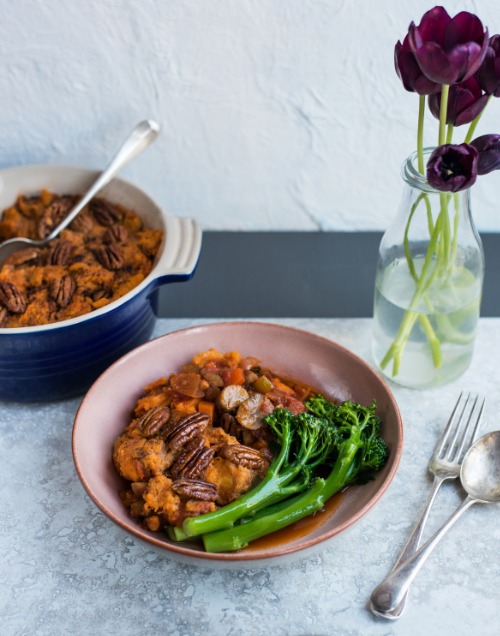 |
| In a pan, heat the olive oil and onion over a medium heat and cook for 2 minutes. Add the carrot, celery and garlic and cook for a further 2 minutes until the vegetables are starting to soften. | |
| Ychwanegwch y cnau castan, tomatos heulsych, afalau, rhosmari a theim ac yna’r tomatos, y piwrî tomatos a’r Marmite a chymysgwch. Rhowch gaead ar y badell, trowch y gwres i lawr a choginiwch am 20 munud, yn troi gyda llwy bren bob hyn a hyn. | |
| Add the chestnuts, sundried tomato, apple, rosemary and thyme then pour in the chopped tomatoes and the tomato puree. Spoon in the Marmite and stir thoroughly. Place a lid on the pan, reduce the heat to low-medium and cook for 20 minutes, stirring occasionally. | |
| Yn y cyfamser, berwch y tatws melys am 15-20 munud, yna ychwanegwch y sudd masarn, yr olew a’r sinamon a’r nytmeg a gwnewch yn stwnsh. | |
| Meanwhile, peel and slice the sweet potato and boil for 15-20 minutes. Add the maple syrup, cinnamon, coconut oil and nutmeg and mash, then set aside. | |
| Cynheswch y ffwrn i 200C. Ychwanegwch y cêl at y caserol a chymysgwch ac yna coginiwch am 10 munud ychwanegol tan fod y cêl wedi ei wywo. Rhowch flas gyda’r halen a phupur. Os nad yw’r badell yn gallu mynd yn y ffwrn, rhowch y cymysgedd caserol mewn dysgl caserol neu dysgl ffwrn a rhowch y stwnsh tatws ar ei ben. Gratiwch y nytmeg drosodd ac ychwanegwch y cnau pecan a rhagor o sinamon. | |
| Heat the oven to 200C. Add the kale to the casserole mixture, stir through and cook for a further 10 minutes until the kale has wilted. Season with sea salt and pepper to taste. If your pan isn’t oven proof, transfer the mixture to a casserole or oven dish and top with a layer of mashed potato. Grate over the nutmeg, add the chopped pecans and another liberal sprinkling of cinnamon. | |
| Rhowch gaead ar y caserol (neu os yn defnyddio dysgl, gorchuddiwch gyda ffoil) a choginiwch am 10-15 munud tan fod y cnau pecan wedi eu tostio ychydig. | |
| Place a lid on the casserole (or if using a dish wrap loosely in foil) and cook for 10-15 minutes until the pecans are slightly toasted. |
Play
Stop
«Prev
| Ar ôl hirddyddion haf, mae’r hydref wedi cyrraedd ac mae’n dymor newydd o ailddechreuadau: rhew ar y glaswellt, dail crensiog a chas bensil newydd sbon, wrth gwrs. Rhyfedd yw hi feddwl bod blwyddyn wedi mynd heibio ers i mi ysgrifennu fy llyfr ryseitiau. Roedd 2017 yn llawn newid: penderfynais adael y 9-5 i fynd yn llawrydd, symudais o Gaerdydd i Abertawe, a ches i gyfle i ysgrifennu llyfr. Nawr, rwy’n meddwl am beth gallaf ysgrifennu nesaf. | After the long days of summer, autumn has finally arrived and it’s time to dust off the cobwebs (‘tis the season for spiders, after all) and start afresh. I always think of the new school year as the season of reinvention, all crisp mornings, crunchy leaves and freshly sharpened pencils. It’s odd to think that this time last year I was writing a cookery book. Life changed a lot in 2017: I went freelance, upped sticks and moved to Swansea, and got a book deal. I never thought that I’d be an author but here I am with one book to my name and wondering what I can write next. |
| Yn fy ngholofn newydd, mi fyddaf yn parablu am bopeth i ymwneud â bwyd – i gyd yn figan, wrth gwrs, ond bydd pawb yn eu mwynhau, rwy’n addo. | In this new column, I’ll share with you my food for thought on eating, cooking and everything in between. Yes, the dishes are vegan, but I promise you that everyone will enjoy them. |
| Ers cyhoeddiad The Occasional Vegan ym mis Mawrth, mae sawl cyfle wedi dod draw i mi siarad ac ysgrifennu am fwyd – ac wrth gwrs, i goginio. Syndod mawr oedd cael gwahoddiad i ymddangos yng Ngŵyl Fwyd Narberth mis diwethaf, yn enwedig gan fy mod wastad yn dweud fy mod i’n ‘home cook’, nid cogydd. | Since it was published earlier this year, The Occasional Vegan has given me plenty of opportunities to write and talk about food – and of course, to cook. When I was asked to appear at Narberth Food Festival last month, I was a little taken aback. After all, I’m a home cook and definitely not a chef. I honestly thought they’d mixed me up with someone else. |
| Mae coginio fel arfer yn weithgaredd ymlacio i mi ond o flaen cynulleidfa mae’n gallu peri ofn. Rhwng fy sesiynau coginio roedd Ludo Dieumegard, uwch-gogydd The Harbourmaster yn Aberaeron, yn gwneud demo, felly roedd angen i mi wneud yn dda. | Cooking is supposed to be a relaxing experience but when you’re doing it in front of an audience it’s anything but. And when king of the kitchen Ludo Dieumegard from top restaurant The Harbourmaster in Aberaeron, is sandwiched in between your two demos the stakes are high. But I had a hungry crowd so I swallowed my nerves and got on with it. |
| Mae siarad a choginio ar yr un pryd bach yn gymhleth ond rwy’n meddwl wnes i lwyddo esbonio sut i goginio’r rysáit, ac ar yr un pryd atebais cwestiynau o’r gynulleidfa ar fod yn figan. | Doing two things at once is always tricky (after all, it’s a myth that women are good at multitasking) but I think I managed to convey what I was doing. As I cooked, I prattled on about my journey into veganism and gave advice on reducing meat and dairy. |
| Er oeddwn yn nerfus, ces i brynhawn braf iawn. Mae Narberth wastad yn ŵyl hyfryd a roedd pobl yn dangos diddordeb go iawn mewn figaniaeth. Rwy’n ddiolchgar ces i’r cyfle i wneud dau demo, gan roedd yr un cyntaf yn wers i mi ar beth oedd yn gweithio – a beth oedd ddim. Dydw i ddim yn mynd i droi’n gymeriad cweit fel Ludo dros nos ond rwy’n teimlo’n fwy hyderus. | Despite the nerves, I had a very enjoyable afternoon. Narberth is a lovely festival and not one person in the audience heckled me, despite most of them being vegan-curious omnivores. I’m quite glad that I did two demos as I learned a lot from the first one about what worked and what didn’t, and used that to make the second one better. I’m not sure that I’ll ever be quite as confident in the kitchen as Ludo but I’ve made a start. |
| Ces i bleser go iawn wrth glywed bod pobl wedi mwynhau fy mwyd felly dyma’r rysáit ar gyfer y stiw. Mae’n reit addas ar gyfer amser yma’r flwyddyn wrth i’r tywydd droi’n oer a gyda’r nosweithiau hir a phenderfynais ychwanegu pwmpen a gwrd hydrefol i’r rysáit. Mae harissa ar werth mewn llawer o archfarchnadoedd mawr ac mewn siopau ethnig, ond gallwch ddefnyddio llwy de yr un o paprica melys a mwg. | And it was cheering to hear so many compliments about the dish that I made. This is a seriously good stew and so easy to make. It’s just what’s needed on these longer nights and as it’s autumn, I added some seasonal squash and pumpkin. You can find harissa at most larger supermarkets or international stores but if you can’t track it down, try using a teaspoon each of smoked and sweet paprika. |
Stiw gwrd, gwygbys ac olewydd gyda harissa
Squash, chickpea and olive stew with harissa
Mae’n reit addas ar gyfer amser yma’r flwyddyn wrth i’r tywydd droi’n oer a gyda’r nosweithiau hir.
| 40-45 munud; Digon i 4 | 40-45 minutes; Serves 4 |
| Cynhwysion 1 taten melys mawr, heb groen ac wedi ei dorri yn ddeisiau 1 gwrd, heb groen, hadau na chnawd, wedi ei dorri yn ddeisiau 1 winwnsyn bach, heb groen ac wedi ei dorri yn ddeisiau 1 x tun 400g gwygbys, wedi ei rinsio a’i draenio 1 x tun 400g tomatos Sudd o 1 lemwn 2 clof garlleg, heb groen ac wedi eu torri’n fân ½ jar 330g o olewydd du heb gerrig 3 llwy de pâst harissa 2 llwy de piwrî tomato 1 llwy fwrdd olew olewydd Halen a phupur Persli, wedi ei dori (dewisol) | Ingredients 1 large sweet potato, scrubbed or peeled and diced 1 medium squash, peeled and diced, flesh and seeds removed 1 small onion, peeled and diced 1 x 400g can chickpeas, rinsed and drained 1 x 400g can tomatoes, chopped or plum The juice of 1 lemon 2 cloves garlic, peeled and chopped or crushed ½ a 330g jar pitted black olives 3 tsp harissa paste 2 tsp tomato puree 1 tbsp olive oil Salt and pepper Chopped flat-leaf parsley (optional) |
| Rhowch sosban fawr dros wres canolig ac ychwanegwch yr olew a’r tatws melys a’r gwrd. Coginiwch am 5 munud, yna ychwanegwch y winwnsyn a’r garlleg a choginiwch am 5 munud arall, yn troi gyda llwy bren yn aml. | 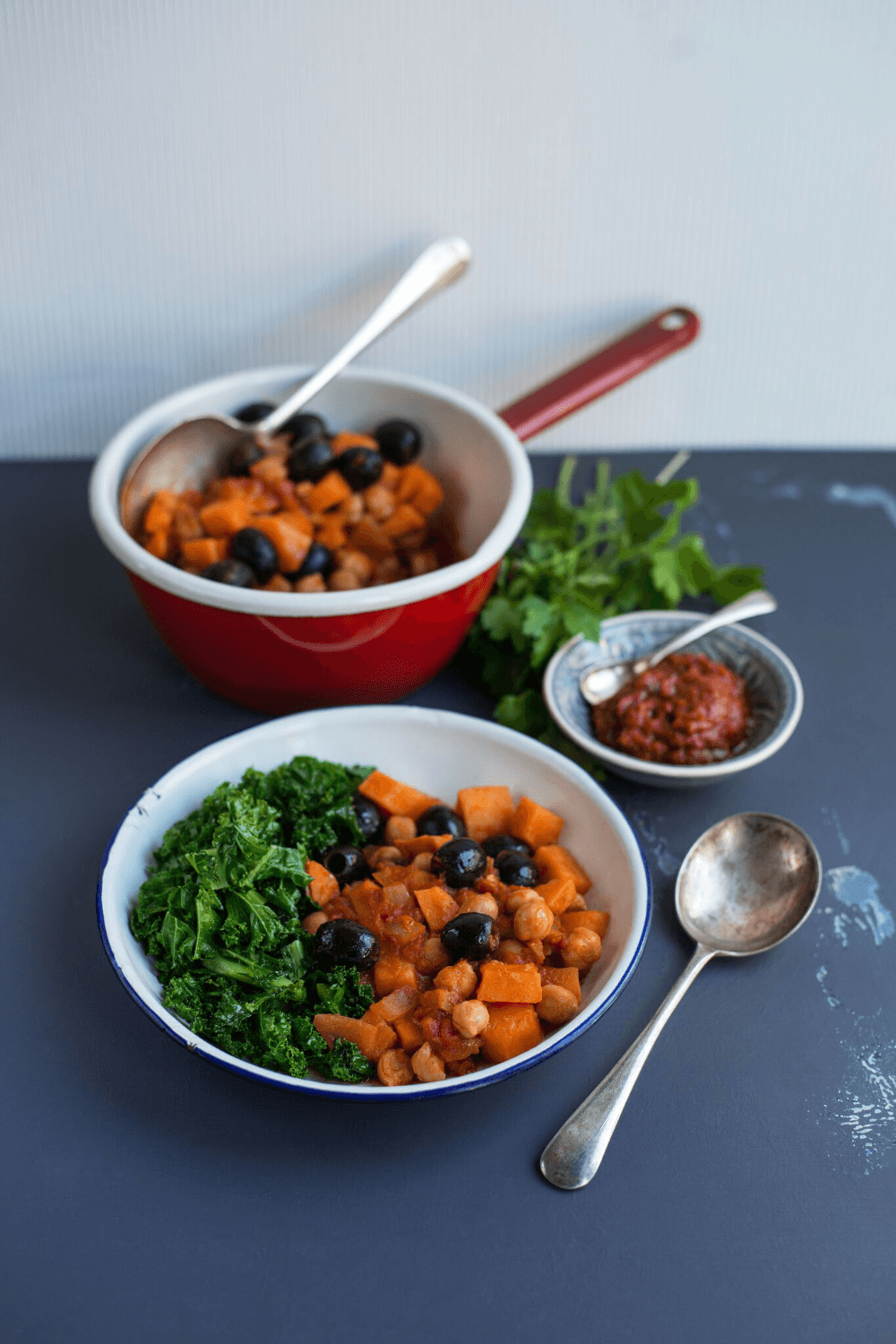 |
| Ychwanegwch y tomatos, yna llenwch y tun gwag gyda dŵr a rhowch yn y sosban. Rhowch flas gyda halen a phupur a throwch y gwres i fyny, yna coginiwch am 10 munud cyn ychwanegu’r gwygbys, olewydd, y pâst harissa a’r sudd lemwn. | |
| Trowch y gwres i lawr a rhowch gaead ar y sosban a choginiwch am 15-20 munud ychwanegol; gallwch ychwanegu rhagor o ddŵr os oes angen. Ychwanegwch y persli, os yn ei ddefnyddio, a gweinwch gyda llysiau gwyrdd neu salad. | |
| Place a large pan over a medium heat then add the oil and the sweet potato and squash. Cook for 5 minutes, then add the onion and garlic and cook for another 5 minutes, stirring frequently. | |
| Add the tomatoes, then fill the empty can with water and add to the pan. Season with salt and pepper then turn up the heat and cook for 10 minutes before adding the chickpeas, olives, harissa paste, tomato puree and lemon juice. | |
| Reduce the heat, place a lid on the pan and cook for a further 15-20 minutes, adding more water if you think it’s necessary. Scatter over the parsley, if you like, and serve with green vegetables or salad. |
sarahphilpott.co.uk / veggingit.wordpress.com / sgphil
serenbooks.com/productdisplay/occasional-vegan
Lluniau gan / Pictures by Manon Houston

Crempogau Afal a Llus / Apple and Blueberry Pancakes
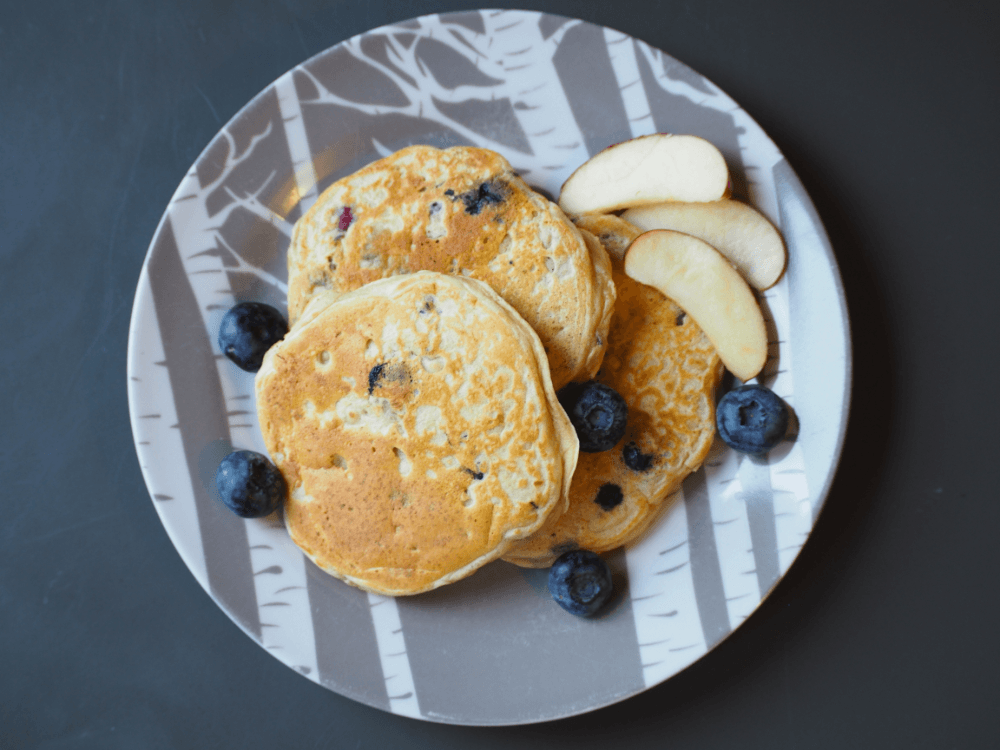
| Mae crempogau’n fwyd delfrydol ar gyfer plant bach sy’n dechrau bwydo eu hunain. Mae’r rhain yn llawn afal a llus, felly maen nhw’n flasus ac yn faethlon. Bydd y teulu cyfan eisiau’r rhain i frecwast. Mae crempogau bach fel hyn yn rhewi’n dda, felly gwnewch fwy na sydd angen pan fydd gennych amser. Maen nhw’n dadmer yn gyflym, neu os ydych chi ar frys mawr gallwch eu taro yn y meicrodon neu’r tostiwr. | Pancakes are an ideal food for small children who are beginning to feed themselves. These are full of apple and blueberries, so they are tasty and nutritious. The whole family will want these for breakfast. Small pancakes like this freeze well, so when you have time make more than you need. They thaw quickly, or if you are in a great hurry you can put them in the microwave or the toaster. |
| 120g o flawd gwenith cyflawn | 120gm wholewheat flour |
| 1 llwy de o bowdr codi | 1 spoonful baking powder |
| ½ llwy de o soda pobi | ½ spoonful baking soda |
| 100ml o laeth | 100ml milk |
| 1 wy | 1 egg |
| 50g o afal wedi’i gratio | 50gm grated apple |
| 55g o lus | 55gm blueberries |
| Menyn i ffrio | Butter for frying |
| Digon i wneud tua 10 crempog fach. | This is enough to make about 10 small pancakes. |
| Cymysgwch y blawd, y powdr codi a’r soda pobi mewn powlen a chymysgu. | Mix the flour, the baking powder and the baking soda in a bowl. |
| Gwnewch bant yn y canol ac ychwanegu’r llaeth a’r wy. Gyda chwisg llaw, cymysgwch bopeth yn ofalus nes eu bod wedi cyfuno’n llwyr. Dylai’r cymysgedd fod yn weddol drwchus. | Make a hollow in the middle and add the milk and egg. With a hand whisk, mix everything carefully until it is completely blended. The mixture should be fairly thick. |
| Ychwanegwch yr afal wedi’i gratio a’r llus a chymysgu eto yn ofalus gyda llwy bren. | Add the grated apple and blackberries and mix again carefully with a wooden spoon. |
| Toddwch ychydig o fenyn mewn padell ffrio dros dymheredd cymedrol a rhoi llond llwy bwdin o’r cymysgedd yn y badell ar gyfer pob crempog. | Melt a little of the butter in a frying pan over a moderate temperature and put one spoonful of pudding from the mixture into the pan for each pancake. |
| Coginiwch am 2 funud ar bob ochr, nes eu bod yn euraidd. | Cook for two minutes on each side, until they are golden. |
| Gwnewch yr un peth â gweddill y cymysgedd. | Do the same thing with the rest of the mixture. |
Tameidiau Twrci / Turkey Nuggets
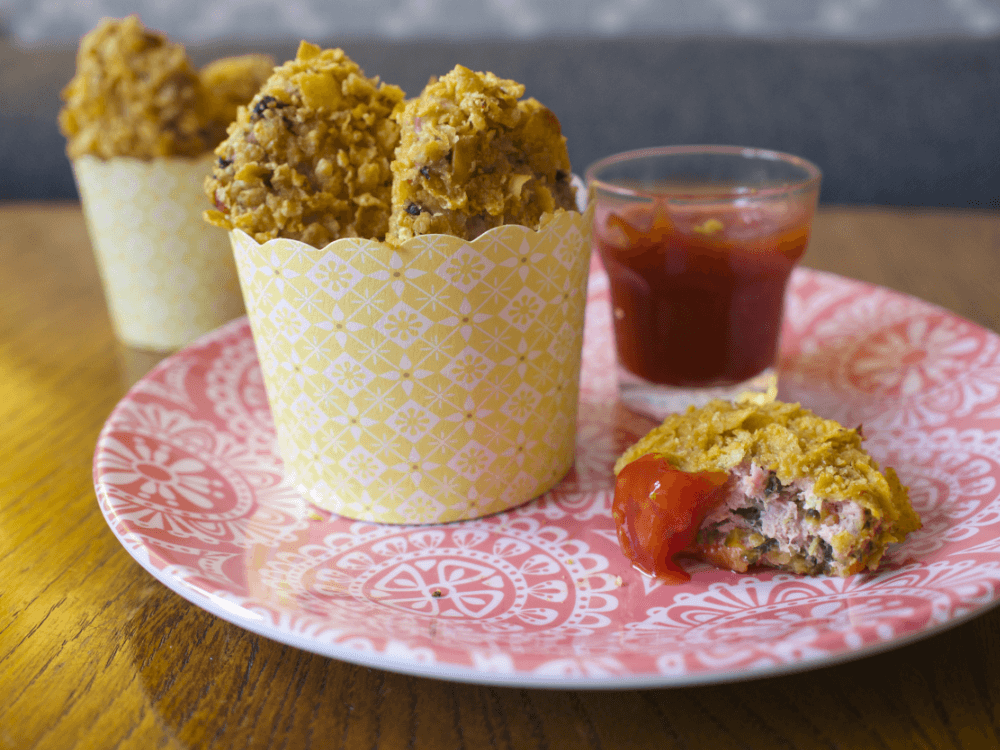
| Os yw eich plant wrth eu boddau â’r tameidiau cyw iâr, neu’r chicken nuggets, sydd ar gael mewn bwytai neu siopau, beth am drio gwneud y tameidiau twrci yma gartref? Heb yr holl halen ac yn llawn llysiau cudd maen nhw’n llawer mwy iach. Ond eto maen nhw’n syml iawn i’w gwneud ac, yn bwysicach oll, yn flasus hefyd. Mae’r rysáit yn cynnwys syniadau am ba lysiau y gallwch eu defnyddio, ond defnyddiwch chi beth bynnag sydd gennych yn y tŷ ar y pryd. | If your children are fond of the chicken pieces, or 'chicken nuggets', which you get in restaurants or shops, what about trying to make turkey nuggets here at home? Without all the salt, and full of hidden vegetables, they will be much healthier, and, more importantly, tasty too. The recipe includes ideas about what vegetables you can use, but use whatever you have in the house at the time. |
| 500g o fins twrci | 500gm minced turkey |
| 20g o gaws parmesan wedi’i gratio’n fân | 20gm parmesan cheese grated small |
| Hanner pupur wedi’i dorri’n fân iawn | Half a pepper in very small pieces |
| 3–4 blodyn brocoli | 3-4 heads of broccoli |
| 3 pelen o sbigoglys wedi’i rhewi (wedi’u dadmer) | 3 balls of frozen spinach (after thawing) |
| 100g o greision ŷd | 100gm cornflakes |
| Digon i wneud rhyw 16. | This is enough to make some 16 nuggets. |
| Cynheswch y popty i 180ºC / Ffan 160ºC / Nwy 4. | Heat the oven to 180ºC / 160ºC Fan / Gas mark 4. |
| Rhowch y cig a’r caws mewn powlen. | Put the meat and cheese in a bowl. |
| Torrwch y llysiau mor fân â phosib, un ai â llaw, neu (yn haws fyth) mewn prosesydd bwyd, a’u hychwanegu at y cig. | Shred the vegetables as small as possible, either by hand or (even easier) in a food processor, and add them to the meat. |
| Defnyddiwch eich dwylo i gyfuno’r cig a’r llysiau a ffurfiwch siapiau neu dameidiau. | Use your hands to mix the meat and vegetables and form into shapes or pieces. |
| Rhowch y creision ŷd mewn bag plastig a’u taro â phin rholio i’w malu’n fân. | Put the cornflakes in a plastic bag and roll with a rolling pin to break them up small |
| Rholiwch y tameidiau cig yn y creision ŷd, gan sicrhau eu bod wedi’u gorchuddio’n llwyr. | Roll the meat pieces in the cornflakes, making sure that they are completely covered. |
| Rhowch nhw ar dun pobi wedi’i leinio â phapur gwrthsaim a choginio am 20–25 munud, a’u troi ar ôl 10 munud. | Put them in a baking tin lined with greaseproof paper and cook for 20-25 minutes, turning them after 10 minutes. |





Mae Gethin Sherrington yw’r pedwerydd mwyaf poblogaidd chef bobydd â hyfforddiant ffiseg yn y Gogledd Ddwyrain, ac yn uno gwyddoniaeth a choginio ar ei flog artisaniaeth.com ac ar YouTube. Mae ei ysgrifennu a’i archwiliadau yn unigryw, felly mae parallel.cymru wrth ei bodd yn cyflwyno ei waith yma. Gethin Sherrington is the fourth-best physics trained baker-chef in all]]>
Warning: Parameter 2 to qtranxf_postsFilter() expected to be a reference, value given in /home/parallel/public_html/wp-includes/class-wp-hook.php on line 324
Gethin Sherrington is the fourth-best physics trained baker-chef in all of North West Wales, and unifies science and cooking on his blog artisaniaeth.com and on YouTube. His writing and explorations is unique, so parallel.cymru is delighted to present his work here.
O blantos bach i’r Michelin chef, dyw wyau’m yn ddieithr i neb. Wyau, yw asgwrn cefn y gegin. Efallai eich bo’n mwynhau ŵy ‘di sgramblo bora ‘ma, neu’n mentro’r drewdod a ca’ brechdan ŵy i ginio. Neu efallai eich bod, fel y gorau ohonom, yn rhythu ar oergell wag, ond mai’n iawn, mae omlet, neu quiche bach, o hyd ar gael. Allwch chi ddeall felly, pam mae wyau yw’r pwnc cyntaf sydd rhaid i ni ddadansoddi, yma ar Artisaniaeth. Y cynhwysyn cymhlethaf cyffredin, yn y gegin.
Eggs. The backbone of the kitchen. Young and old, toddler to Michelin, we’re all ovivorous beings. Perhaps you’ve just had some scrambled eggs for breakfast, or braving the stink of an egg mayo sandwich for lunch. Or maybe there’s just nothing in the fridge, but it’s OK, because there’s always omelet, or a quick quiche, for dinner. It’d be appropriate then, that the first deep dive article on Atrisaniaeth, should be on eggs. They are, after all, simultaneously the most complex, and the most commonplace ingredient there is.
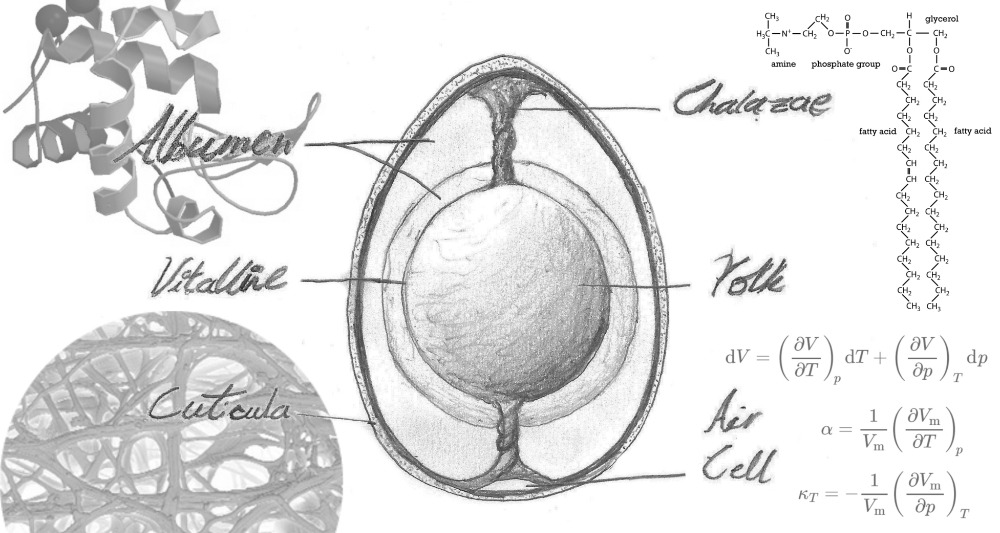
| Problem Dŵy-ran "You couldn't boil an egg" dywed wrth y prentis, amheuaeth o'i anallu at dasg hollol syml. Ar y llaw arall, dewin yw'r dyn all alw o'r ŵy, riw facaron neu soufflé diwall. | An Egg-stream Dichotomy "You couldn't boil an egg" , whilst, conjuring a macaron, or hot soufflé is considered wizardry. |
Any sufficiently advanced technology is indistinguishable from magic. - Arthur C. Clarke |
|
| Nid i ddweud bod wyau o hyd am fod tu hwnt i'n dealltwriaeth. Ond eu bod nhw'n gymhlethach na'r edrychom. Mor ansefydlog, ac ansicr a'n barn ni amdanyn nhw. | That isn't to say that eggs are beyond our comprehension. It simply means they're complex and bipolar by nature. |
| Wedi'r cyfan, dyblyg yw natur ŵy, ei hun yn gynhwysyn o gynhwysion; o wynnwy, ac o felynwy. Tra bod y melyn efo canran cyfartal o ddŵr i fwynau, protein a braster, mae'r gwynnwy, neu albwmen, yn 90% dŵr efo'r gweddill yn brotein pur. Ond, ar y cyfan, mae'r albwmen a'r melynwy yn rhannu protein yr holl ŵy yn gyfartal rhyngddynt! | By definition, an egg is its self an ingredient of ingredients; the yolk, and the whites. Whilst yolks are a 50/50 blend of water with various fats, proteins and mineral compounds, the whites, or albumen, are almost 90% water the remainder being pure protein. However, taken as a whole, the yolk and albumen contain equal amounts of protein, sharing the egg's overall protein content 50/50. |
| Protein felly, yw gwir werth wyau yn y gegin. Dyma pam cawn wyau ym mhopeth, o gacenni a thartenni i saws stir fry. Cadwyni Carbon ydyn nhw, efo llu o grwpiau cemegol ynghlwm â nhw. Mae'r grwpiau yma'n achos y cadwyni i glymu a chysylltu efo'i gilydd, a dyma sy'n rhoi bywyd i'n bwyd, a'n bywydau. | Protein then. It's important! It's why eggs end up everywhere from cakes and tarts to soups and fry ups. They're long chains of Hydrocarbons, bonded with all sorts of functional groups. These groups are what produce such wide varieties of protein interaction, and which give life to us, and to our food. |
| Gwres: Injan ein bwyd Gwres yw'r teclyn gorau i chwarae efo protein, mesur o egni cinetig pob moleciwl mewn sylwedd. Efo mwy o wres yn cyfieithu i fwy o egni, a mwy o symudiad, yn y molecylau. | Teggnology at Work Heat, is the most basic protein manipulator, a measure of the kinetic energy possessed by all molecules within a given substance. The hotter something gets, the faster, and more energetic it's molecules become. |
| Efo protein, gall wres achosi pob math o newidiadau. Yn gyntaf, gall strwythur y protein newid. Efo'r holl grwpiau cemegol lawr hyd enfawr y moleciwl, bydd anghyfartaledd rhwng gwefrau yn ymddangos rhwng adrannau o'r protein. Y canlyniad yw protein sy'n plygu a chorddi'r wrth i'r adrannau anghytbwys yma atynnu a gwrthyrru'i gilydd. Wrth ychwanegu gwres, gall y protein oresgyn y grymoedd electrostatig 'ma, i ddatglymu. | With regard to proteins, heat can cause many different things to occur. Firstly, the protein's structure can change. Due to their sheer size, proteins will often have unbalanced charges running along their lengths. This leads to the protein bunching and knotting its self up, as different sections of the protein are attracted and repelled by one another. Heating a protein and increasing it's energy can therefore allow the protein to overcome these forces between sections, causing it to unfurl, like a loose shoelace on a long run. |
| Wrth i'r protein agor allan, bydd y gwefrau anghytbwys yn rhydd i ymrwymo mewn ffyrdd hollol newydd, a gyda phroteinau hollol wahanol. Yn y modd yma, mae ail effaith gwres ar brotein yn ymddangos; ei allu i gynyddu cyflymder. Er mwyn cael proteinau'n adweithio, rhaid bod nhw'n cwrdd, ac er mwyn cwrdd, rhaid iddyn nhw symud...lot. | Once a protein has unfurled, the unbalanced charges along it's length will be free to bond in new ways and with other proteins. This is another affect heating has on protein. Not only does the protein have the energy to untangle its self, but it can also move around more, increasing the probability of it colliding with another unfurled protein and bonding with it. |
|
|
| Mae cynhesu protein yn arwain at broteinau yn dadrwymo, gwrthdaro a bondio, i greu rhwydwaith cadarn sy'n dal dŵr. Ceulo (coagulate) yw'r enw ar y broses hon, sy'n golygu felly mae gel yw ŵy wedi' gwcio. Gel sy'n tynhau, caledu, a cholli dŵr wrth gynhesu'n bellach. | If you imagine this scenario, you can start to see why eggs tend to solidify as they're heated, with egg proteins unfurling, colliding, and bonding as heat is applied and their energy increases. This is what leads to coagulation, where the egg sets into a semi sold structure and is no longer a liquid. |
| I wneud bywyd yn anoddach, mae'r gwahaniaeth rhwng protein y gwyn a'r melyn yn achosi i'r ddau geulo ar dymereddau hollol wahanol. Does felly'r fath beth a'r ŵy perffaith, mond riw 'sbectrwm o barodrwydd' efo ond rhannau o'r ŵy 'di gwcio'n berffaith. Cam Cogino & Tymheredd Gwynnwy yn twchu 145ºF/63ºC Ovotransferrin, sef 12% o brotein y gwyn, yn ceulo 150ºF/65ºC Melynwy yn dechrau twchu 150ºF/65ºC Melynwy yn ceulo'n llawn 158ºF/70ºC Holl wynwy'n caledu (Ovalbumin, protein pennaf y gwyn, yn ceulo) 180ºF/80ºC, | The differing protein types and concentrations in our eggs also means that there's no clear cut temperature at which an egg is 'done', instead, you have a temperature spectrum: Cooking Process & Temperature Whites thicken 145ºF/63ºC Whites become solid (ovotransferrin, 12% of total albumen protein content) 150ºF/65ºC Yolk starts to thicken 150ºF/65ºC Yolk Sets 158ºF/70ºC Whites become firm (Major albumen protein, ovalbumin, coagulates) 180ºF/80ºC, |
| Dyma pam bod rheolaeth fanwl o gwcio wyau'n agos i amhosib! Dim rhyfedd bod chwedlau a rheolau tybiedig yn rhemp trwy'n ceginau. | Given the evidence, it's no wonder why so many myths and supposed rules are circulating about eggs, and why precisely manipulating eggs, is such a challenge for cooks. |
| Mae felly angen dadansoddiad trylwyr o'r wyau 'ma'. I'w cracio ar agor, i weld yn union beth sydd yn mynd ymlaen o dan y plisgyn bach eiddil na. Ychwan-egg-u, llwyed o reolaeth I ddeall yn union sut mae rheoli'n wyau, dwi am i ni edrych ar wyau trwy lygaid cyfarwydd. I wneud hyn, rydym am edrych ffefryn i bawb: wyau 'di sgramblo. | Today, we'll really crack open our eggs, to see exactly what's going on beneath that fragile shell of theirs. |
| Braster Pam dadlau; 'llaeth, yntau fenyn?' mewn ŵy 'di sgramblo? Mae gymaint o amrywiaeth rhwng yr holl ryseitiau perffaith ŵy 'di sgramblo mewn Google search, waeth i chi chwilio am yr un gwaethaf ddim! | Fat Why 'milk, or butter?' in scrambled eggs. It's a debate that's been raging for decades. Look for the perfect scrambled egg recipe, and you'll find no more agreement between them than you would the worst recipe. |
| Ond un peth cyffredin welwch chi, sy'n gwahaniaethu'r goreuon o'r gwaethaf, fydd braster. Pam felly? Pa bŵer sydd gan fraster dros yr ŵy? Mae'r ateb, fel y disgwylir, i gyd yn y protein. | One thing you will notice, however, is that the best scrambled eggs, will always contain fat. Why? What magical property does fat possess that produces such an improvements? It's all in the protein. |
| Mi rydym ni'n gwybod yn barod bod wyau, wrth eu cynhesu, yn ceulo, wrth i broteinau tu mewn iddynt dad ac ailymrwymo. Ond, os ddaliwn i gynhesu, dal i dynhau gwna'r proteinau. Mae'r wyau'n torri, mewn geiriau eraill. | We already know that when eggs are heated, protein inside will begin to unravel and bond, leading to coagulation. However, as we continue heating, beyond coagulation, the proteins tighten, and the eggs split, into big, chewy curds. |
|
|
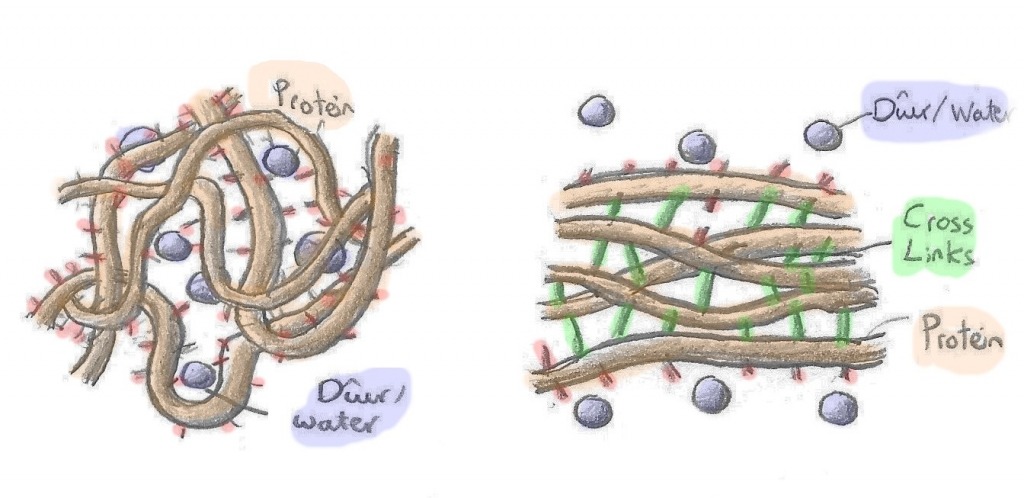
| Proteinau ŵy yn mynd o anrhefn (chwith) i drefn, wedi' bondio'n glos (dde) wrth eu cynhesu. | Egg proteins go from disorganised and loose (left) to organised and tightly bound (right) as they're heated. |
| Tebygolrwydd yw gwres yn y bôn. Yr uchaf yw'r gwres ar ein ŵy y mwyaf yw'r siawns bod dau brotein ynddo yn cyfarfod a'n bondio. Tra bo hyn yn digwydd, mae dŵr yn yr ŵy yn prysur droi i stem, sy'n arwain at wyau ysgafn, ffluffy. Er hynny, bydd rywfaint o ddŵr yn aros ynghlwm i'r ŵy, yn sownd yn y clymau proteinau sy'n ffurfio. Dyma le ddaw gwead tendar wyau da 'di sgramblo, a lle ddaw'r gwead rwber dyfrllyd 'na o mewn wyau gwael, lle mae gor-gwcio wedi arwain at broteinau tyn sy'n gwthio dŵr allan o'u meinwe. Sut felly, mae braster am sortio hyn i gyd? | Heating increases the chance of a chemical bond forming between two proteins. Whilst this is happening, water in the eggs is turning to steam, contributing to the 'fluffiness' that we look for. Meanwhile, some moisture is retained, lending a tenderness to the cooked eggs. However, as cooking continues and more bonds form, the protein network tightens, and water is forced out, leading to the a dry, overcooked texture. So what's fat to do with all this? |
|
|
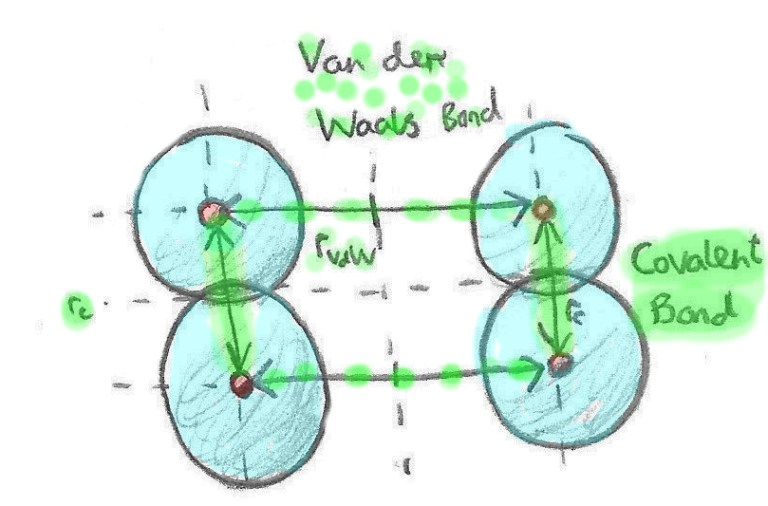
| Blanced i brotein, dynna yw braster. Er bod bondio protein-protein llawer cryfach (bondiau cofalent), mi wneith braster fondio i brotein. Mi wna hyn drwy rymoedd gwan rhyngfolecylaidd (Van der Waals) sy'n deillio o anghyfartaledd rhwng gwefrau molecylau. Be olygai hyn felly yw bod braster yn gwneud hi'n anodd iawn i brotein fondio i'w gilydd yn gryf, heb fod molecylau braster yn eu ffordd. Y canlyniad yw bod y proteinau'n bondio'n arafach felly'n dal dŵr yn hirach ac felly'n cynhyrchu'r wyau fluffy 'da ni ar eu hol. | Fat, as it turns out, coats protein. Although not quite as strong as protein-protein (covalent) bonds, fat and protein will loosely bond via inter-molecular (Van der Waals) forces from charge imbalances. The result is protein-protein bonds won't form as readily in the presence of fat. This slows down the bonding process, leading to greater water retention between protein, resulting in fluffier eggs. |
|
|
| Protein wyau'n cael eu cynhesu efo (chwith) a heb (dde) fraster. Fel y gwelwn, mae braster yn lleihau colledion dŵr drwy rwystro rhyngweithio rhwng protein. | Egg proteins heated with (left) and without (right) fat. Fat reduces water loss by inhibiting protein interaction. |
| Dyma pam bo' ryseitiau da wyau 'di sgramblo yn gofyn am riw ffurf o laeth neu fenyn. Ond mae dal terfyn i allu braster, a faint fedrwn i ychwanegu. Er enghraifft, mi wneith ychwanegu llefrith gynyddu’r dŵr yn ein hwyau, yn o gystal â'r braster. Mae dŵr yn medru dal lot o wres felly wrth gyflwyno mwy o ddŵr, mi rydym ni'n cynyddu’r amser gymerith hi i'r wyau gwcio (angen mwy o wres). Ar yr un llaw, mae hyn yn beth da i wyau 'di sgramblo, gan ei fod o'n debygol o gynhyrchu mwy o stem wrth bobi, sydd yn arwain at wyau mwy ysgafn. Ar y llaw arall, os oes angen i'r wyau gwcio'n o handi, mi fedd mwy o ddŵr yn niweidio ansawdd yr wyau. Er engrafiff, os ydw i'n paratoi omlet, mi fydd y cynnydd mewn amser cwcio yn arwain at omlet sydd mwy fel gwadan esgid na brecwast soffistigedig. | This is why dairy added to eggs produces tender, fluffier cooked eggs. But there is a limit to how much we can add. Adding milk, for example, increases the water content of the eggs, thereby significantly increase their heat capacity and hence, cooking time. On the one hand, this is good for scrambled eggs as it will generate more steam and have more moisture to retain, however, for an omelet, which needs to be more compact and foldable, the added liquid will prolong the cooking time, toughening the omelet. |
| Dyma pam mae ryseitiau omlet yn aml yn awgrymu ychwanegu menyn i'r badell, ac nid at yr wyau. Gan fod cynnwys braster menyn llawer uwch na llefrith (cyfrannedd o tua 4:1, braster i ddŵr, lle bo' llefrith yn agosach at 1:30!). Unwaith mae'r wyau'n cael eu hychwanegu i'r badell, mae'r menyn tawdd yn gweithio ei ffordd drwy'r gymysgedd ŵy, yn gorchuddio'r proteinau heb gynyddu’r amser cwcio gormod. (Ffordd hyd yn oed mwy slei o wneud hyn yw ychwanegu menyn 'di rewi i'r badell. Y syniad yw bo o'n arafu cwcio jest digon iddo allu lledu trwy'r ŵy yn fwy trylwyr na menyn sy'n boeth yn barod). | This is why omelet recipes will more often ask for you to butter the pan, instead of the eggs. Butter has a much higher fat to water ratio than milk (around 4:1, as opposed 1:30!). Once eggs are added to a buttered pan, the butter disperses throughout the egg, coating the protein in fat and producing a tender omlet, without significantly increasing its cooking time. (An even craftier trick is to use frozen butter in the pan as it will melt slowly and disperse more evenly throughout the eggs as they cook). |
| Halen Tarddbwynt bob chwedl coginio sy'n mynd. Cewch chi ddim un gegin, heblaw am un ateb sy'n bendant ar y mater o halltu wyau. Tra bo un cogydd yn halltu bob cam o'r ffordd, mi wneith un arall ddal bob gronyn yn ôl nes bo'r ŵy yn barod i'w blatio. Beth felly ydym ni i wneud efo'r holl straeon 'ma? Ymchwilio, wrth gwrs! | Salt The greatest myth maker of them all. Whilst some chefs salt all their eggs, others won't let a grain near them until the dish is seconds from service. What are we to make of all this then? The answer, as always, is in the science. |
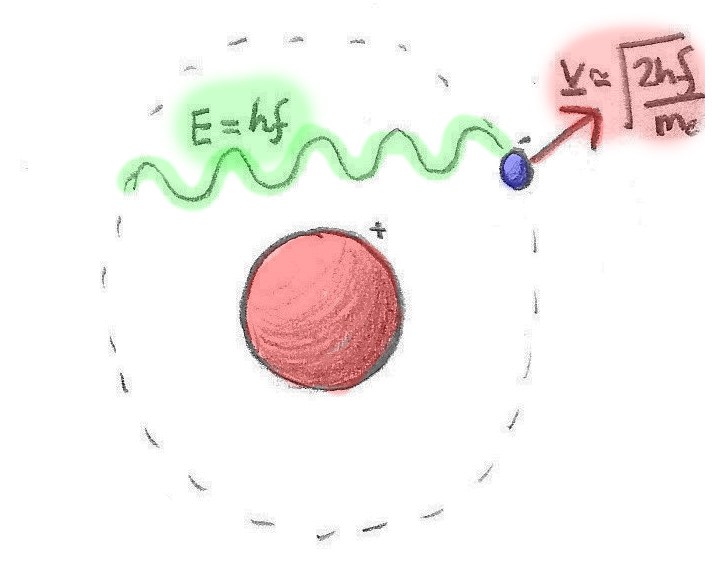
| Os edrychwn i'n ôl i'n dyddiau TGAU Cemeg, mi gofiwn i fod halen yn sylwedd cyfansawdd ïonig. Golygai hyn bod yr atomau sy'n eu cyfansoddi yn atynnu ei gilydd drwy rym electrostatig rhwng ionau â gwefrau gwrthwynebol. Yn achos halen, anion negatif Clorin sy'n rhannu bond ïonig efo catïon positif Sodiwm. | Salt, as we all fondly recall, is defined as an ionic compound formed of two charged ions, a negative anion, and positive cation. In the case of table salt, we have a Sodium cation sharing an ionic bond with a Chlorine anion. |
|
|
| Sodium yn bondio i Clorin wrth drosglwyddo electron iddo, i ffurdio dau ion positif a negatif | Sodium atom bonds to Chlorine by donating an electron, forming positive and negative ions |
| Mae'r ionau yna’n medru effeithio'r wyau mewn dwy ffordd. Trwy rymoedd rhyngfoleciwlaidd (grym rhwng proteinau) a mewnfoleciwlaidd (o fewn proteinau). | These ions effect egg proteins in two ways, influencing the intermolecular (force between) and intramolecular (force within) interaction between proteins. |
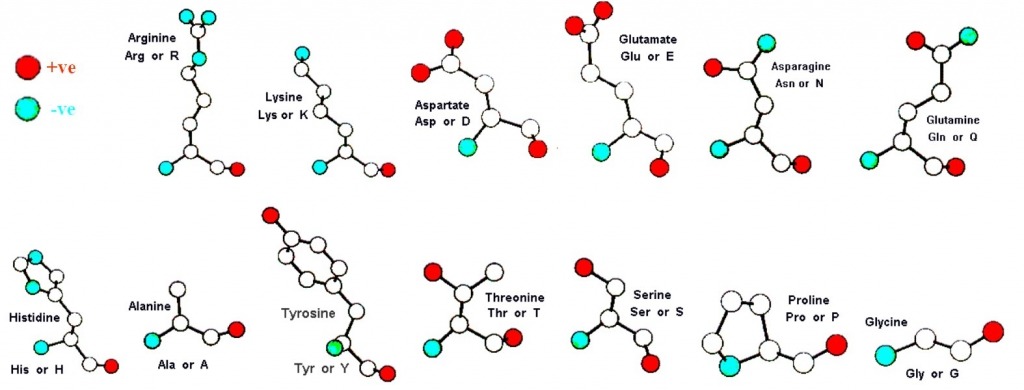
| Edrychwn ni gyntaf ar y grymoedd mewnfoleciwlaidd. Wrth ychwanegu halen at wyau, y peth cyntaf ddigwyddith yw bod yr halen yn hydoddi. Hynny yw, mi rannith y crisialau halen lawr i'w ionau cyfansawdd, Sodiwm a Chlorin. Wedi hydoddi, mi symudith yr ionau tuag at ranbarthau o wefrau anghytbwys. Gan fod y gwefrau rhanbarthol 'ma'n rhemp o fewn, ac ar hyd proteinau, mi wneith halen achosi i broteinau ddatod yn haws, drwy gydbwyso'r gwefrau'r sy'n eu dal at ei gilydd. | Firstly, let's look at the intramolecular forces. When we add table salt to uncooked egg, it dissolves, splitting into it's constituent Sodium and Cloride ions. These ions will then seek out and neutralise regions of opposing charge, which occur all along the length of the egg proteins. With charge imbalances neutralised, sections of the protein will no longer attract one another, allowing the protein to unfurl. |
|
|
| Strwythur yr 20 asid amino a lleoliad eu gwefrau | The charge configurations of the 20 amino acids |
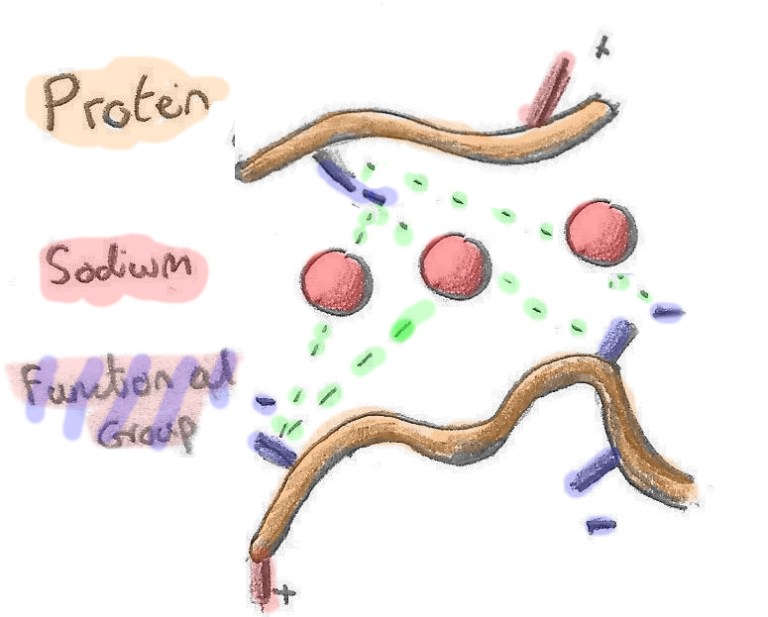
| Yr ail effaith mae halen yn ei gael wrth gwrs, yw'r effaith rhyngfoleciwlaidd. Tueddu tuag ato fo'n gyfan gwbl negatif yw proteinau ŵy felly mi fydd y catïon Sodiwm (gwefr bositif) yn tueddu i gasglu o'u cwmpas. Mi wneith hyn, yn ei dro, achosi i fwy o broteinau gasglu o'u cwmpas nhw ac felly ar y cyfan, mi fydd angen llai o egni i'r holl beth geulo. Golygai hyn y bydd wyau 'di halltu'n fwy parod i geulo, ac ar dymheredd is na rhai heb eu halltu. Catalydd felly yw halen ar gyfer i ryngweithio proteinau. | Secondly, Sodium cations will attract the overall negative egg proteins, which converge around them. Easier convergence means greater intermolecular interaction between proteins, meaning salted eggs coagulate more readily, and at a lower temperature, than unsalted eggs. Salt therefore behaves as a catalyst for protein interaction, lowering the energy required for two proteins to interact. |
|
|
| Ond mae gan halen dric bach arall buddiol. Er bod yr ionau'n tynnu proteinau at ei gilydd, mae dal angen lle arnynt. Be sy'n digwydd felly yw bo mas ffisegol yr ionau'n yn rhwystro'r proteinau rhag casglu'n rhy agos at ei gilydd. Bydd hyn yn arbed y rhwydwaith proteinau rhag bondio'n rhy dyn, sydd felly'n gwneud hi'n anoddach gor gwcio'r wyau. Felly mae halen yn cadw'ch wyau'n ysgafn a hufennog am hirach. | However, it also makes overcooking more difficult as the ions that bring the proteins together also act as a buffer, keeping them from getting too close. This inhibits the protein network from becoming too tight, so your eggs stay creamier and fluffier for longer. |
| Dyna i chi eich ateb felly yn de! Gwyddoniaeth (go drwm) o'r diwedd wedi rhoi Wil i'w wely! Mi ddylech chi fo'n halltu eich wyau cyn pobi er mwyn macsimeiddio'r dŵr sy'n cael ei ddal ac i finimeiddio'r amser pobi sydd ei angen i gael wyau tendar ac ysgafn. | So there's your answer! Science (and some pretty heavy science at that) has answered our prayers! You should be salting your eggs before cooking to help maximize water retention and minimize cooking time for even more tender and fluffy results. |
| Finegr, Sudd Lemon a sylweddau asidig eraill Os mae natur ïonig halen sy'n arwain at yr holl ddadlau ma’, pam felly bod asid yn cael ei absenoli o'r ddadl? Cyrd Lemon yw'r ateb i hynnu. | Vinegar, Lemon Juice and other acids Another culinary quirk of electrostatics for you here. If salt is such a controversial topic that's all about the ions, why isn't acid on the top 10 kitchen controversies scale? Lemon curd is all I can say to that. |
| Diolch i On Food and Cooking, a rysáit wyau 'di sgramblo gan Le Patissier françois, mae'n bur debyg mae dechrau bywyd fel wyau 'di sgramblo gwnaeth y cyrd lemon cyntaf. Yn y rysáit, mae o'n galw am ychwanegu sudd grawnwin 'di chwerwi at wyau melys, wrth ychwanegi y byddai sudd lemon neu oren hefyd yn opsiwn. Beth sy'n gyffredin am y tri sudd yma yw eu bod nhw i gyd yn cynnwys asid. Mae sudd grawnwin, gydag amser, yn datblygu asid ethanoig drwy ocsidiad ethanol (sydd ei hun yn gynnyrch o eplesu glwcos a ffrwctos gan furum naturiol ar groen y grawnwin) ac mae sudd lemon a sudd oren yn cynnwys asid sitrig naturiol. | Courtesy of On Food and Cooking, and a scrambled egg recipe from Le Patissier françois, it turns out that lemon curd started life as a sweetened scrambled egg recipe that used sour grape juice instead of milk, and which stated that lemon or orange juice could also be used. What these three juices have in common is that they all contain acid. Sour grapes contain ethanoic acid from the oxidization of ethanol (which is its self a by product of glucose and fructose fermentation performed by wild yeast present on the grape's skin) and both lemons and oranges naturally contain citric acid. |
|
|
| Ion Hydrogen, proton rhydd: yr hyn sy'n gwneud asid yn asidig | What makes acid acidic: hydrogen ions |
| Yn fras, sylwedd sy'n cynnwys atomau Hydrogen yw asid. Atomau Hydrogen wedi colli electron i fod yn fanwl gywir, sy'n gwneud asid yn gawl o brotonau rhydd. | Acid, at its most fundamental, is a liquid containing Hydrogen atoms. Hydrogen atoms that all have their electrons missing in fact, which means they're just protons, floating units of positive charge. |
| Yn union fel ionau Sodiwm mewn halen, mae ychwanegu asid at wyau'n cyflwyno llu o wefrau positif i'r proteinau ŵy. Y cryfaf yw'r asid, yr uchaf yw crynodebau'r ionau. Wedi'u hychwanegu, mi geith yr ionau Hydrogen yr union un effaith ar y proteinau a'r halen, yn lleihau'r tymheredd ceulo sy'n arbed gor gwcio. | Just like liberating those free Sodium cations from salt, adding an acid to eggs introduces a slew of positive charges to the egg proteins. The stronger the acid, the higher the concentration of ions. The Hydrogen ions then act like the salt, lowering the coagulation temperature, preventing overcooking. |
| Dyma sut mae cyrd lemon yn ffurfio. Efo crynodebau mor uchel o ddŵr ac ionau Hydrogen, mi wrthodith yr wyau geulo'n gyfan gwbl. Yn lle, mi wneith y gymysgedd ffurfio gel, a dyma ydym ni'n adnabod fel cyrd. | This is how lemon curd forms. With high concentration of water and Hydrogen ions present, heated eggs will simply refuse to bond fully. Instead, they'll form a gel that we refer to as a curd. |
| Siwgwr Gymaint a ydym ni wrth ein boddau efo siwgwr ym myd pobi, amhurdeb yn unig yw siwgwr mewn wyau. Maint ffisegol y molecylau siwgr sy'n rhwystro proteinau rhag rhyngweithio. Mae ychwanegu siwgwr at wyau felly'n cynyddu’r tymheredd ceulo a'n arbed yr wyau rhag malu (fel y gwelwn mewn cacen) | Sugar As revered as it is in the baking world, sugar in eggs behaves very similar to fat, as an impurity. The presence of large sugar molecules physically getting in the way of the proteins serves to inhibit protein interaction. This then means that adding sugar to eggs will increase their coagulation temperature, inhibiting curdling and overcooking. |
| Ond, beth sy'n ddiddorol yw'r ffaith bod siwgwr yn rhwystro proteinau ŵy rhag datod yn y lle cyntaf, yn y camau cyntaf o gynhesu. Wrth ryngweithio efo'r clympiau protein, mae molecylau siwgwr yn cynyddu'r grym mewnfoleciwlaidd sy'n gwneud hi'n anoddach ceulo wyau melys. | Interestingly however, sugar also inhibits egg proteins from initially unfolding by increasing the intramolecular forces binding proteins to themselves. This makes it even more difficult to curdle eggs with sugar added to them. |
| Peth arall mae siwgwr yn wneud sy'n unigryw iddo yw dal dŵr. Molecylau pegynol yw rhai siwgwr (neu swcros i fod yn dechnegol), sy'n golygu bod gan ei folecylau un pen positif a phen arall negatif. Mae molecylau dŵr hefyd, yn begynol, ac felly mae grym atynnol cryf rhwng pegynau molecylau dŵr a siwgr. | One thing that sugar does do better than anything else however is attract water. Sugar (or sucrose) is a polar molecule, meaning it has both a positive and a negative charge. Sugar also strongly attracts water, another highly polar molecule, making sugar hygroscopic, water attracting. |
| Dyma pam bod siwgwr mor hanfodol i chwipio meringue, o natur hygrosgopig y siwgwr. Erthygl arall, i ddiwrnod arall yn fanno! | This lends its self well when making a meringue due to the hygroscopic properties of sugar, which prevents egg foams from leaking. An article topic unto its self, and maybe, for another day! |
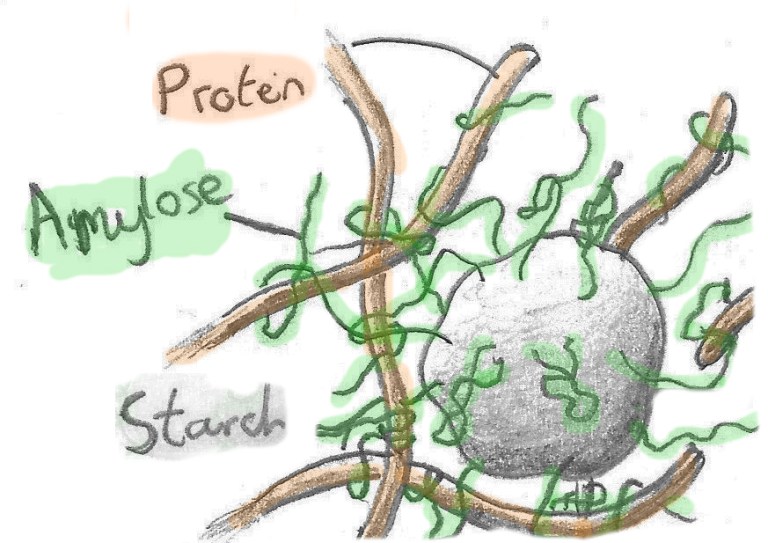
| Starts Mae starts, fel braster a siwgwr, yn ymddwyn fel amhurdeb, yn gwanhau'r crynodeb protein sy'n arwain at dymheredd ceulo uwch. Ond efallai bod hyn yn symleiddio gormod. | Starch Starch, like fat and sugar, bulks up the egg mixture, diluting the protein concentration thereby increasing egg coagulation temperature. |
| Tua dwywaith trymach na swcros, mae starts (amylos ac amylopectin) yn ddigon mawr i lapio ei hun i mewn i ronyn sffêr garw. Fel bownsars y byd bwyd, mae presenoldeb yn unig yn arbed bob math o ryngweithio cemegol. | Starches are particularly effective due to their sheer size. They're large, spherical granules, that, much like a food science bouncer, will simple block interactions from occurring. |
|
|
| Ond mae pethau diddorol yn digwydd wrth i ni eu cynhesu. Wrth i'r starts gynhyrfu, mae'r gronyn yn dechrau dadfeilio, ac mae molecylau llai, fel amylos, yn dechrau ymestyn ohono. Wrth i'r tentaclau siwgwr yma ledaenu, mi gymerant nhw afael yn y proteinau o'u cwmpas, yn ei gwneud hi'n anoddach byth i'r proteinau rwydweithio. | One interesting thing about starch however is that when heated, they'll release some of their own trapped molecules. One such molecule is amylose, a long chain sugar that's released from the starch granule and much like a tentacle, will coat the egg proteins to make it even more difficult for a protein network to form. |
| Dyma pam bod hi'n bosib pobi cwstard i 82°C cyn bod o'n hyd yn oed dechrau twchu, lle bod wyau ben ei hunain yn ceulo ar 65°C. Dim bod hyn yn gwneud y broses pobi'n haws. Yr unig beth mae'r starts yn gwneud yw codi'r pwynt ceulo i dymheredd llawer anoddach i'w reoli. Dyma pam bod creu cwstard ŵy esmwyth yn gymaint o gamp, a pam bod angen bod mor ofalu yn pobi cwstard, fel crème brûlée. | This is why egg custards can be heated to 82°C before thickening whilst eggs will coagulate around 65°C. This doesn't make it any easier however as all you've done is increased the temperature at which the custard will curdle to a higher, less manageable temperature. This is one of the reasons why being able to make a smooth egg custard is such a valued skill, and why baked custard such as crème brûlée are so delicate. |
| Mae o hyd mwy i'w ddysgu... Felly dyna i chi, yn union sut mae deall yr ŵy 'di sgramblo perffaith. Os ydych chi'n ysu i ymarfer yr hyn ydych chi newydd ddysgu, 'dwi'n eich herio i drio ein rysáit Cyrd Lemon, ac i ddweud wrthym ni sut hwyl gafoch chi yn y comments! | There's always more to learn... So there you have it, the answer to the perfect scrambled egg! If your feeling adventurous though, you can tackle our Lemon Curd recipe and let know how you get on in the comment. But for now go out and utilize your newfound egg theory. Brunch domination is now firmly in your grasp. |



artisaniaeth.com / youtube.com/channel/UC0mEoGDw7GKMta-OAQNecLA
